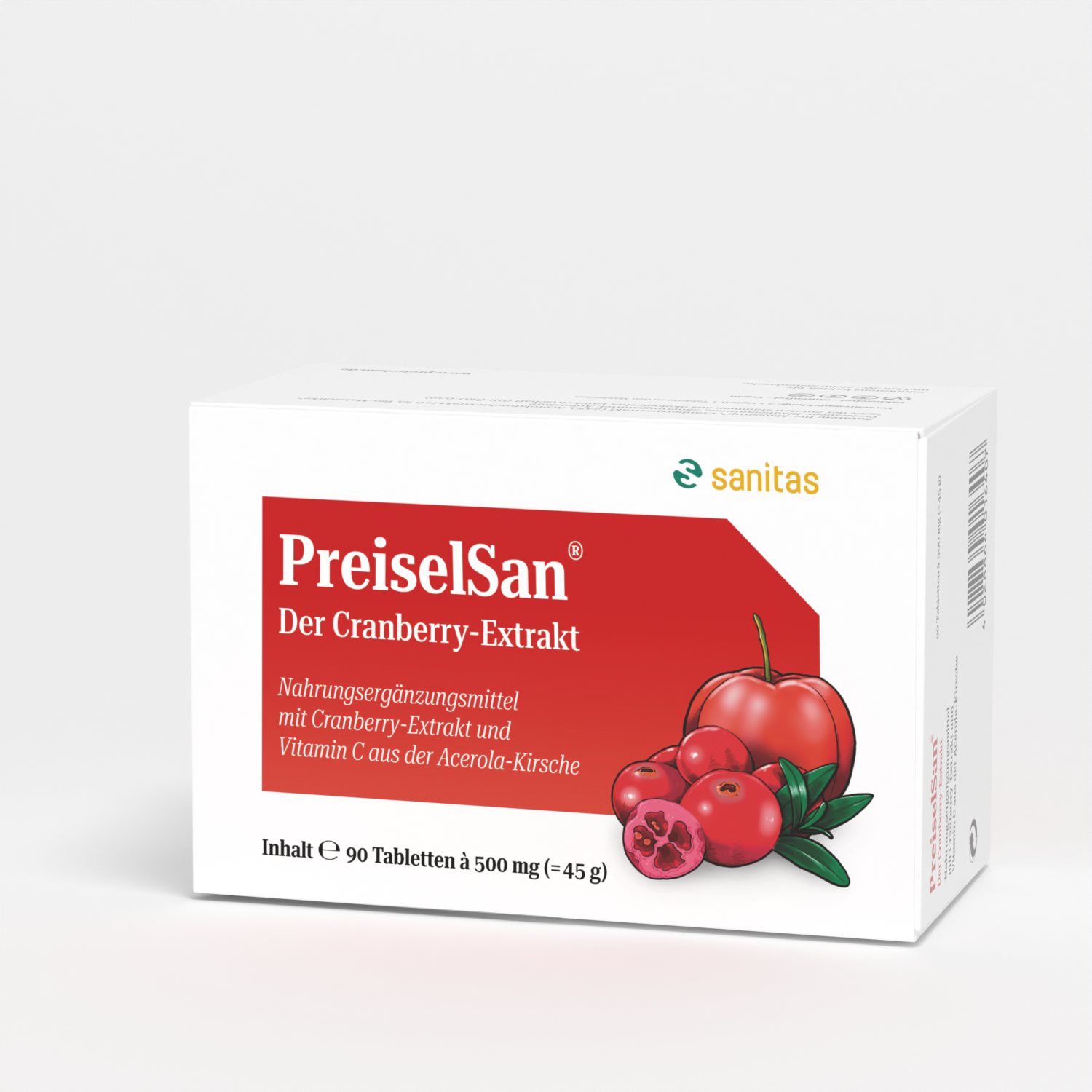
PREISELSAN®
Cranberry extract + acerola vit. C
Cranberry extract is obtained from the fruits of the cranberry (Vaccinium macrocarpon), the large-fruited cranberry. The small, sour berries are rich in bioactive compounds, especially proanthocyanidins (PAC), a specific group of flavonoids.
Traditionally, cranberry is used primarily in connection with urinary tract health. This very area of use is also the subject of numerous scientific studies.
Steckbrief
The scientific focus for cranberry is on the urinary tract. It is discussed that the proanthocyanidins it contains could make it more difficult for certain bacteria, especially E. coli, to adhere to the mucous membrane of the urinary tract. This mechanism is the common explanation for the traditional use.
The body of research on this is extensive but not consistent in its findings. One widely noted systematic review concludes that cranberry products may contribute to preventing recurrent urinary tract discomfort in certain groups of people, while other studies found no clear effect. Important for context: this refers to prevention in the sense used in the studies, not the treatment of an existing infection. An acute urinary tract infection should always be assessed by a doctor.
Cranberry extract is available as capsules, tablets, powder, or juice concentrate. For extracts, the proanthocyanidin (PAC) content is often stated, as it is considered decisive for the discussed effect. Many studies used preparations with a defined PAC content.
Compared to sweetened cranberry juices, standardized extracts have the advantage of providing the active compound without a relevant amount of sugar. Follow the recommended intake of the respective product.
Cranberry products are generally considered well tolerated in typical amounts. Larger amounts may cause gastrointestinal discomfort in sensitive individuals.
A possible interaction with coumarin-type anticoagulant medications (such as warfarin) should be taken into account: an influence on coagulation values has been discussed here. Anyone taking such medications should coordinate use with a doctor. Caution is also advisable for those prone to kidney stones. Persistent or recurring urinary tract discomfort should always be assessed by a doctor.
Cranberry extract + acerola vit. C
Organic cranberry extract + organic acerola vit. C
Research primarily looks at cranberry in connection with preventing recurrent urinary tract discomfort, not the treatment of an acute infection. The findings are inconsistent. An existing case of cystitis should be assessed by a doctor.
PAC are a specific group of flavonoids in cranberry that are considered decisive for the discussed effect on the urinary tract. Many standardized extracts state their PAC content.
Standardized extracts provide the proanthocyanidins without the sometimes considerable amount of sugar found in sweetened juices. For targeted use, they are therefore usually the more practical form.
The name dates back to a time when the large-fruited cranberry was still marketed in Germany under the name “Preiselbeere” (lingonberry), before the English term “cranberry” became established. Botanically, the cranberry (Vaccinium macrocarpon) is closely related to the native lingonberry (Vaccinium vitis-idaea), but not identical to it.
Fachliche Prüfung
Prof. Dr. med. Dr. phil. Martin Hörning
Arzt, Professor i.R. und Mitbegründer von sanitas
Seit 40 Jahren beschäftigt er sich intensiv mit den Themen Prävention, Gesundheitsförderung, Achtsamkeit, Longevity und Naturheilverfahren. In Herstelle führt er eine kleine Privatpraxis.