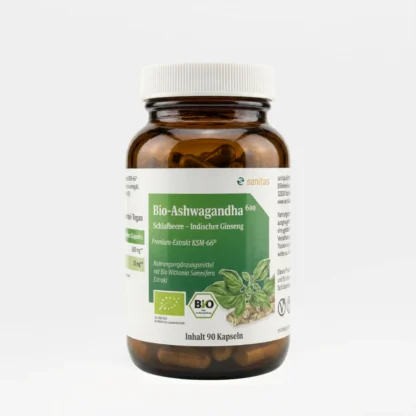
Organic Ashwagandha 600
Premium KSM-66® extract with 30 mg of withanolides per daily dose
Ashwagandha (Withania somnifera), also known as Indian ginseng or winter cherry, is one of the most extensively studied medicinal plants in Ayurvedic tradition. It grows in India, parts of Africa, and the Middle East, where it has been used for centuries. In Western discourse, it is classified as an adaptogen—a plant substance intended to help the body better cope with various stressors.
The root is predominantly used. It contains a characteristic group of bioactive compounds called withanolides, to which most of the studied effects are attributed. This profile summarizes the current state of research on Ashwagandha, typical usage, and what to keep in mind when taking it.
Steckbrief
Ashwagandha is one of the few herbal adaptogens backed by a series of controlled human trials. Research primarily focuses on stress perception, sleep, and physical performance. Most studies utilize standardized root extracts over periods of eight to twelve weeks.
Several placebo-controlled studies in chronically stressed adults report lower subjective stress levels when taking standardized extract, as measured by established questionnaires. A subset of these studies also showed lower morning cortisol levels. While promising, the findings stem predominantly from smaller studies and should not be misinterpreted as evidence of a therapeutic effect.
A systematic review and meta-analysis synthesized multiple studies in which participants taking Ashwagandha reported improved self-assessed sleep quality. More pronounced effects tended to be seen in individuals who initially experienced difficulty falling asleep or staying asleep.
In athletic contexts, Ashwagandha has been investigated in studies examining strength building, endurance, and post-exercise recovery, including trials in exercising men and women. Reported outcomes include improvements in strength measurements and recovery parameters. Here too, the evidence is based on isolated studies with limited sample sizes.
In summary, the current research points toward a favorable profile regarding stress, sleep, and recovery, without providing grounds for definitive therapeutic claims. Further and larger studies are needed to define its effects and appropriate applications more precisely.
Studies typically utilize standardized root extracts. Common daily amounts range from approximately 300 to 600 mg, depending on the extract and standard, often standardized to a defined withanolide content. Crucial for comparability with clinical studies is not simply the raw milligram figure, but the type of extract and its active compound concentration.
Ashwagandha is typically taken as a capsule or powder. Due to the effects on sleep described in studies, some users prefer taking it in the evening, though this is not mandatory. The effects reported in clinical trials generally emerged only after several weeks of consistent use, rather than following single doses.
Follow the recommended intake of the respective product, and view dietary supplements as a complement to a balanced lifestyle, not as a substitute for sleep, exercise, and recovery.
Standardized Ashwagandha extracts were predominantly well tolerated across the study periods examined. Occasionally reported potential side effects include gastrointestinal discomfort or drowsiness. Data on the safety of very prolonged, continuous use remain limited, as most studies are restricted to a few weeks.
In the following situations, Ashwagandha should not be taken without prior medical consultation:
Ashwagandha belongs to the nightshade family. Individuals with known sensitivities to this plant family should take this into account. When in doubt, consult your physician, particularly if you take regular medication.
Premium KSM-66® extract with 30 mg of withanolides per daily dose
In available clinical trials, observable changes usually appeared after several weeks of regular use, typically after about four to eight weeks. Ashwagandha is not designed to produce an immediate effect after the first dose.
There is no scientifically prescribed specific time of day. Due to the effects on sleep described in studies, many users take Ashwagandha in the evening. More important than the exact time is regular, daily intake over a sustained period.
Standardized means that the extract is formulated to contain a defined proportion of characteristic active compounds—in the case of Ashwagandha, withanolides. Only then is the dosage comparable to the preparations used in clinical studies.
Most studies have run for eight to twelve weeks. Fewer data exist regarding very long-term, continuous use. If you plan to take Ashwagandha over an extended period, it is advisable to discuss this with a physician.
During pregnancy and breastfeeding, with thyroid or autoimmune conditions, and when concurrently taking certain medications, Ashwagandha should only be used after consulting a physician.
Fachliche Prüfung
Prof. Dr. med. Dr. phil. Martin Hörning
Arzt, Professor i.R. und Mitbegründer von sanitas
Seit 40 Jahren beschäftigt er sich intensiv mit den Themen Prävention, Gesundheitsförderung, Achtsamkeit, Longevity und Naturheilverfahren. In Herstelle führt er eine kleine Privatpraxis.