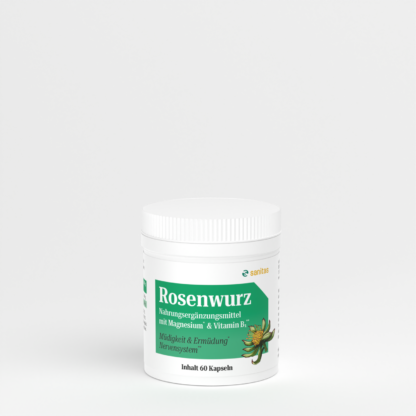
Roseroot
Rhodiola rosea + Magnesium + Vit. B1
Rhodiola rosea, also known as Golden Root, is a perennial plant that grows in the cold mountainous regions of Siberia, Scandinavia, and other parts of Europe and Asia. It has a long tradition in the folk medicine of these regions.
Like ashwagandha, Rhodiola rosea is classified as an adaptogen—plants intended to support the body’s ability to adapt to stress. Traditionally, the focus is on its relationship to stress, exhaustion, and mental and physical performance.
Steckbrief
Roseroot is traditionally used in connection with stress-related fatigue as well as mental and physical performance. Rosavins and salidroside are considered characteristic compounds, and extracts are frequently standardized to them.
Several human studies on Rhodiola rosea are available, investigating, among other things, stress-related exhaustion and endurance performance. While some of these studies report beneficial effects, their methodological quality and conclusive strength are mixed. Under European health claims regulations, no authorized health claims exist for roseroot as a dietary supplement. The current body of scientific evidence provides indications, but no confirmed health claims.
Roseroot is mostly available as a standardized root extract in capsule or tablet form, frequently standardized to a defined content of rosavins and salidroside. Studies have predominantly utilized such standardized extracts.
Traditionally, roseroot is taken during the day rather than in the evening, as it is associated with activation and performance. It is often used in cycles. Please follow the dosage recommendations provided on the respective product.
Standardized roseroot extracts were generally well tolerated in studies over the investigated periods. Restlessness, irritability, or sleep disturbances are occasionally reported, which is why late-evening intake is usually avoided.
Due to insufficient data, roseroot should not be taken during pregnancy and breastfeeding without consulting a doctor. In cases of mental health conditions, particularly bipolar disorders, or when taking antidepressants or other medications, medical consultation is advisable. Persistent fatigue should always be evaluated by a medical professional.
Rhodiola rosea + Magnesium + Vit. B1
Adaptogens are plant-based substances intended to support the body’s resilience to physical and mental stress. In addition to roseroot, ashwagandha also belongs to this group. The term originates from 20th-century research.
Roseroot is traditionally taken during the day, as it is associated with activation and performance. Taking it late in the evening is usually avoided due to potential restlessness.
Standardized extracts indicate their content of rosavins and salidroside, the characteristic compounds. Only in this way is the application comparable to the preparations used in clinical studies.
Fachliche Prüfung
Prof. Dr. med. Dr. phil. Martin Hörning
Arzt, Professor i.R. und Mitbegründer von sanitas
Seit 40 Jahren beschäftigt er sich intensiv mit den Themen Prävention, Gesundheitsförderung, Achtsamkeit, Longevity und Naturheilverfahren. In Herstelle führt er eine kleine Privatpraxis.