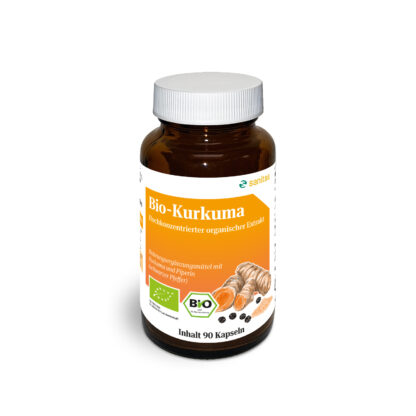
Organic Turmeric 800
Organic turmeric extract + organic pepper extract
Turmeric (Curcuma longa), also known as yellow ginger, is a member of the ginger family from South Asia and gives many curry blends their characteristic yellow colour. This is due to the main active compound curcumin, a secondary plant compound from the polyphenol group.
In Ayurvedic and traditional Chinese medicine, turmeric has been used for a long time. Today, curcumin is one of the most intensively studied plant compounds in scientific research, mainly because of its antioxidant properties.
Steckbrief
Curcumin, the main active compound in turmeric, is the subject of a large number of scientific studies. Research primarily focuses on its antioxidant properties as well as its relationship with inflammatory processes, digestion, and other areas. Traditionally, turmeric is primarily associated with digestion.
Despite the abundance of studies, the classification must be viewed with nuance: many results come from laboratory or animal studies, and the natural absorption of curcumin in humans is low. In accordance with European Health Claims regulations, no health-related claims are permitted for curcumin as a dietary supplement. Current research provides promising approaches, but no confirmed healing claims.
A central topic regarding turmeric is bioavailability: pure curcumin is only absorbed by the body to a small extent. For this reason, many preparations combine curcumin with piperine, the pungent substance in black pepper, which is intended to significantly improve absorption. Special galenic forms also aim for better absorption.
Turmeric is available as a spice, powder, capsule, or standardized extract. In the case of extracts, the curcuminoid content is often specified. Since curcumin is fat-soluble, absorption from the spice is enhanced by preparation with a little fat. When using supplements, please follow the recommended intake.
Turmeric as a spice is considered safe. Concentrated extracts in higher dosages can cause gastrointestinal discomfort in sensitive individuals.
In the case of gallstones or a blockage of the bile ducts, turmeric should not be taken in concentrated form without medical consultation, as it can stimulate bile flow. Since curcumin can influence blood clotting and the metabolism of certain medications, medical consultation is advisable when taking anticoagulants and other medications, as well as before surgery. During pregnancy and breastfeeding, concentrated preparations should only be used after consultation.
Organic turmeric extract + organic pepper extract
Turmeric is the spice, i.e., the dried and ground root. Curcumin is the main active compound contained within it. In the spice, curcumin only makes up a small proportion; standardized extracts concentrate it.
The pungent substance in pepper, piperine, significantly improves the absorption of curcumin in the body. Since pure curcumin is poorly absorbed, this combination is very common.
As a spice, turmeric provides only small amounts of curcumin, which is also poorly absorbed. Preparation with a little fat and black pepper promotes absorption. Standardized extracts are used for specifically higher amounts.
In the case of gallstones, when taking blood-thinning or other medications, as well as during pregnancy and breastfeeding, concentrated preparations should only be used after medical consultation.
Fachliche Prüfung
Prof. Dr. med. Dr. phil. Martin Hörning
Arzt, Professor i.R. und Mitbegründer von sanitas
Seit 40 Jahren beschäftigt er sich intensiv mit den Themen Prävention, Gesundheitsförderung, Achtsamkeit, Longevity und Naturheilverfahren. In Herstelle führt er eine kleine Privatpraxis.